
As an Amazon Associate I earn from qualifying purchases.
You need an 88 key keyboard synthesizer that fits your hands, your wallet and your workflow. Whether you’re practicing late at night, building tracks in a DAW or playing live, the wrong keybed or sound engine can kill your flow.
Touch response, included sounds and connectivity decide how long a synth stays on your stand. These six picks cover every budget and use case without repeating models or colours.
We ranked them by how well they serve real creators: portability vs power, keys vs controllers, and beginner tools vs pro features.
This guide shows what each one delivers, where it falls short, and who should buy it today.
Our Top 6 88 Key Keyboard Synthesizer Picks at a Glance
| Product | ||
|---|---|---|
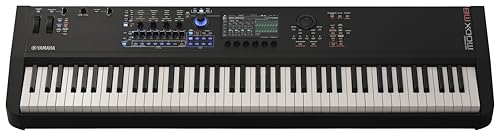 |
Yamaha MODX M8 88-Key Synthesizer Studio producers & performers |
Check Price |
 |
Roland JUNO-D8 88-Note Synthesizer Live players & giggers |
Check Price |
 |
Yamaha MX88 88-Key Synthesizer Classical & motif fans |
Check Price |
 |
Alesis Recital Play 88-Key Piano Bundle Beginners & teachers |
Check Price |
 |
M-Audio Keystation 88 MK3 Controller DAW users & virtual synths |
Check Price |
 |
Arturia KeyLab Essential mk3 88 Key Controller Composers & producers |
Check Price |
Top 6 88 Key Keyboard Synthesizers: Detailed Reviews
1. Yamaha MODX M8 88-Key Synthesizer
The Yamaha MODX M8 is a flagship 88-key synth built for pianists who want deep sound design without the bulk. It packs three synth engines—classic analog, modern FM, and realistic instruments—so you can switch between warm pads, sharp leads, and acoustic piano tones instantly. The graded hammer action feels like a real piano, while the Super Knob and eight faders let you tweak sounds in real time without digging through menus. A color touch screen and dedicated knobs make editing faster than ever, whether you’re on stage or in the studio.
What We Like:
- Three synth engines give you endless sound possibilities from vintage to modern
- Super Knob and faders let you shape sounds live without stopping your performance
- Graded hammer action feels like a real piano, even in a lightweight body
- Color touch screen and dedicated knobs speed up sound editing significantly
- ESP plugin lets you use MODX M8 sounds in your DAW for seamless workflow
What Could Be Improved:
- Heavy for a gigging keyboard—better suited for studio or fixed setups
- Learning curve for new users due to the depth of features
- No built-in speakers, so you’ll need amps or headphones
Buy the MODX M8 if you’re serious about sound design and need a pro-level 88-key synth. Skip it if you’re a beginner or need portability and built-in speakers.
2. Roland JUNO-D8 88-Note Synthesizer
The Roland JUNO-D8 is a stage-focused 88-key synthesizer built for live players who need reliable sound and playability. Its hammer-action keyboard delivers a piano-like touch, while the ZEN-Core engine powers over 3800 onboard sounds—acoustic pianos, organs, synths, and more—so you can switch between genres without hunting for patches. The gig-ready design includes USB-C battery power for mobile setups, and you can import your own WAV samples to customize sounds on the fly. It’s designed to keep up with fast-paced performances without technical distractions.
What We Like:
- Hammer-action keys feel like a real piano, not a budget keyboard
- 3800+ sounds cover everything from grand pianos to synth leads
- USB-C battery power lets you gig without a power outlet
- Sample import lets you load your own WAV files for custom tones
- Intuitive layout keeps live tweaking quick and frustration-free
What Could Be Improved:
- No aftertouch on the keys, limiting expressive control
- Screen is small and low-resolution, making sound browsing slower
- Bundled sounds are solid but not groundbreaking for pros
Buy the JUNO-D8 if you need a no-fuss, battery-powered keyboard for live shows. Skip it if you want deep sound editing or aftertouch for expressive playing.
3. Yamaha MX88 88-Key Synthesizer
The Yamaha MX88 is an 88-key weighted synthesizer built for players who want acoustic realism without the bulk of a full workstation. Its GHS weighted action mimics a real piano’s heavier bass and lighter treble, so your muscle memory translates naturally. The Motif sound engine lets you layer up to eight elements into a single voice, which is perfect for crafting rich, evolving sounds on the fly. VCM modeling adds vintage warmth to effects and processors, giving your patches that analog character you can’t get from stock plugins.
What We Like:
- GHS weighted keys feel like a real piano, making it ideal for classical players
- Class-compliant USB audio/MIDI means you can plug it into a computer and start playing immediately
- Motif engine’s layering and zoning let you stack sounds for complex textures
- VCM modeling adds vintage warmth to effects without extra hardware
- 128-note polyphony handles live playing and sequencing without dropouts
What Could Be Improved:
- No built-in speakers, so you’ll need headphones or an amp
- LCD screen is basic and not touch-sensitive
- Limited onboard effects compared to full workstations
Buy the MX88 if you want a no-frills, piano-like weighted keyboard with Motif’s sound engine for classical or motif-based music. Skip it if you need built-in speakers, advanced effects, or a touchscreen display.
4. Alesis Recital Play 88-Key Piano Bundle
The Alesis Recital Play 88-Key Piano Bundle is a lightweight, portable keyboard designed for beginners who want a full 88-key experience without breaking the bank. Its 88 touch-sensitive keys mimic an acoustic piano, helping you build finger strength and dexterity. The 480 built-in voices and 160 rhythms let you experiment with different sounds and genres, while the one-touch song mode makes recording simple. USB-MIDI connectivity lets you connect to a computer for additional lessons or recording software.
What We Like:
- 88 full-size, touch-sensitive keys for realistic piano playing
- 480 voices and 160 rhythms for broad creative flexibility
- Built-in lesson modes and metronome for structured practice
- USB-MIDI compatibility for use with recording and education software
- Includes stand, sustain pedal, and headphones for a complete setup
What Could Be Improved:
- Speakers are weak for larger rooms, so headphones are often needed
- Touch sensitivity is basic—advanced players may find it limiting
- No aftertouch or weighted keys, which restricts expressive playing
Buy this if you’re a beginner or teacher needing an affordable, all-in-one keyboard with lessons and connectivity. Skip it if you want advanced piano dynamics or a more powerful sound system.
5. M-Audio Keystation 88 MK3 Controller
The M-Audio Keystation 88 MK3 is a compact 88-key MIDI controller with semi-weighted keys, designed to give you hands-on control over virtual instruments and DAWs. The keys feel responsive enough for basic piano work but won’t replace a real piano’s action. Transport controls and a volume fader let you record and mix without touching your mouse, while pitch and mod wheels add expressive touches. USB power means one cable handles both data and power, ideal for laptop setups where outlets are scarce.
What We Like:
- Semi-weighted keys provide a balanced feel between synth and piano action for everyday playing.
- Built-in transport controls streamline recording workflows in most DAWs.
- USB-powered, so it works anywhere without needing a separate power supply.
- Comes with a solid bundle of software including Ableton Live Lite and MPC Beats.
- Slim design fits easily on desks or small studio spaces.
What Could Be Improved:
- Semi-weighted keys lack the heft of a real piano, which may frustrate advanced players.
- No aftertouch, so expressive performances are limited to velocity and wheels.
- Software bundle feels dated compared to newer free alternatives.
Buy this if you need a no-frills 88-key controller for virtual instruments and DAW control on a budget. Skip it if you demand piano-like key action or advanced features like aftertouch.
6. Arturia KeyLab Essential mk3 88 Key Controller
The Arturia KeyLab Essential mk3 is an 88-key MIDI controller with a hybrid synth-piano keybed that feels closer to a stage piano than most budget controllers. Chord Mode lets you play full voicings with single notes, while Scale Mode locks you to a key for instant melodic correctness. Deep DAW integration means dedicated scripts for Ableton Live, Logic Pro X, and FL Studio, so transport controls and macros work without extra setup.
What We Like:
- Hybrid keybed delivers a responsive, piano-like feel across the full 88 keys
- Chord Mode turns simple note presses into rich, playable chords instantly
- Deep DAW integration with custom scripts for Ableton Live, Logic Pro X, and FL Studio
- 2000 presets in Analog Lab Pro cover modern hybrids, orchestral, and vintage sounds
- RGB pads with velocity and pressure sensitivity add expressive performance options
What Could Be Improved:
- DAW integration scripts require manual install for some hosts
- No built-in audio interface—you’ll need a separate audio interface or DAW outputs
- Hybrid keybed is heavier than standard synth-action keys, which may fatigue fingers during long sessions
Buy this if you want a full-size controller that feels like a real instrument and integrates tightly with your DAW. Skip it if you need built-in audio or prefer ultra-light synth-action keys.
How to Choose Your 88 Key Keyboard Synthesizer
Picking the right 88 key keyboard synthesizer hinges on how you plan to use it. The first split is between a controller and a standalone instrument. Controllers send MIDI to a computer or tablet and rely on software for sound generation. Standalone synths include their own sounds and effects, so you can play without a connected device. If you only need keys for virtual instruments, a controller saves money and keeps your setup lean. If you want to play gigs or practice without a laptop, a standalone model is the safer choice.
Sound engine and presets
Sound engine determines the character of the instrument. Sample-based engines reproduce acoustic sounds convincingly but can eat storage space. Virtual analog engines model classic synths and offer tweakable parameters. FM synthesis delivers bright, digital tones popular in electronic music. Preset count matters less than preset quality—look for banks that match your style. You can always expand later with user libraries, but factory sounds should inspire you immediately.
Key action and build
Key action is the feel of the keys under your fingers. Synth-action keys are light and fast, good for rapid runs. Weighted hammer-action keys mimic a piano, offering resistance and dynamic response. Semi-weighted splits the difference and suits many players. Build quality affects durability and portability. Plastic housings save weight but flex under heavy use. Metal frames last longer but add bulk. If you gig often, prioritize a sturdy chassis and a protective case.
Connectivity and extras
Ports define how the keyboard fits into your workflow. USB-MIDI is essential for controllers. Audio outputs let you route the sound to monitors or interfaces. Pedal inputs add sustain or expression control. MIDI over Bluetooth removes cables for mobile setups. Some models include arpeggiators, sequencers, or audio interfaces. Extras can justify a higher price if you use them daily, but they’re useless if you never touch them.
Frequently Asked Questions
Do I need an 88-key keyboard if I’m a beginner?
Not necessarily. A 61-key or 76-key model saves space and cost while covering most beginner material. Upgrade to 88 keys when you outgrow the smaller range or need weighted keys for technique.
Can I use a synthesizer as a MIDI controller?
Yes, but only if it has USB-MIDI and no built-in sound engine you want to use. Controllers are lighter and cheaper, but synths with audio outputs can also send MIDI.
What’s the difference between synth-action and weighted keys?
Synth-action keys are lighter and faster, ideal for fast passages. Weighted keys mimic a piano’s resistance and response, better for classical training and dynamics.
How important are aftertouch and pitch bend wheels?
Aftertouch adds expression but isn’t essential for most players. Pitch bend is more useful for bending notes and vibrato. If you play lead synth lines, prioritize these controls.
Should I buy a bundle with stands and pedals?
Bundles save money if you need the extras. Check the included items—some stands are flimsy, and sustain pedals may feel cheap. Compare prices before deciding.
Which 88 Key Keyboard Synthesizer Should You Buy
The Yamaha MODX M8 stands out as the best overall 88 key keyboard synthesizer for studio producers and performers. It delivers a powerful sound engine, responsive keys, and robust connectivity in one package. If you need a simpler, more portable option, the Roland JUNO-D8 is the best alternative for live players who value reliability and ease of use. Choose the MODX M8 for depth and the JUNO-D8 for straightforward performance.